
RC-PINE Peptide | EDR Neuroprotection and Cognitive-Aging Research
$42.00
RC-PINE (EDR) is a synthetic tripeptide (Glu-Asp-Arg) studied for its potential role in neuronal function, cellular resilience, oxidative-stress responses, gene-expression pathways, and age-related neurological research. Researchers have investigated Pinealon in laboratory models involving neuroprotection, cognitive aging, and neuroplasticity.
For laboratory research use only. Not for human or veterinary use.
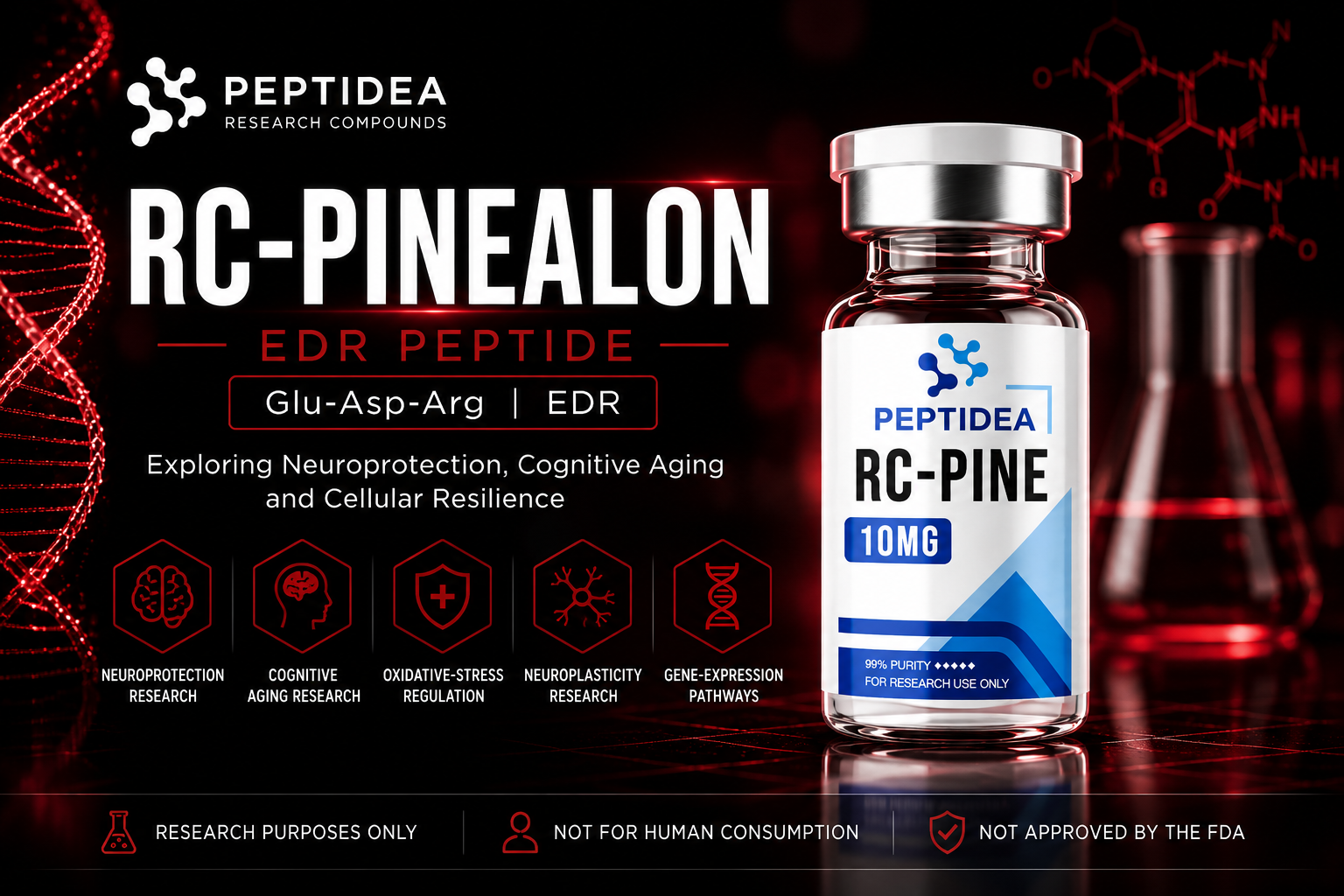
RC-PINEALON
Exploring Neuroprotection, Cognitive Aging, and Cellular Resilience
Pinealon, also known as the EDR peptide, is a synthetic ultrashort peptide composed of three amino acids:
Glutamic Acid – Aspartic Acid – Arginine
It is commonly written as:
Glu-Asp-Arg | EDR
Pinealon has attracted research interest because of its potential involvement in neuronal protection, gene-expression regulation, oxidative-stress responses, and age-related changes within the nervous system.
What Is Pinealon?
Pinealon is classified as a tripeptide bioregulator. Unlike larger peptides, it contains only three amino acids.
Researchers have investigated EDR for its potential ability to interact with cellular pathways associated with:
- Neuronal function
- Cellular stress responses
- Protein synthesis
- Gene expression
- Neuroplasticity
- Age-related neurological changes
Pinealon should not be confused with Epitalon. Although both are ultrashort peptides studied within the field of peptide bioregulation, they have different amino-acid sequences and research applications.
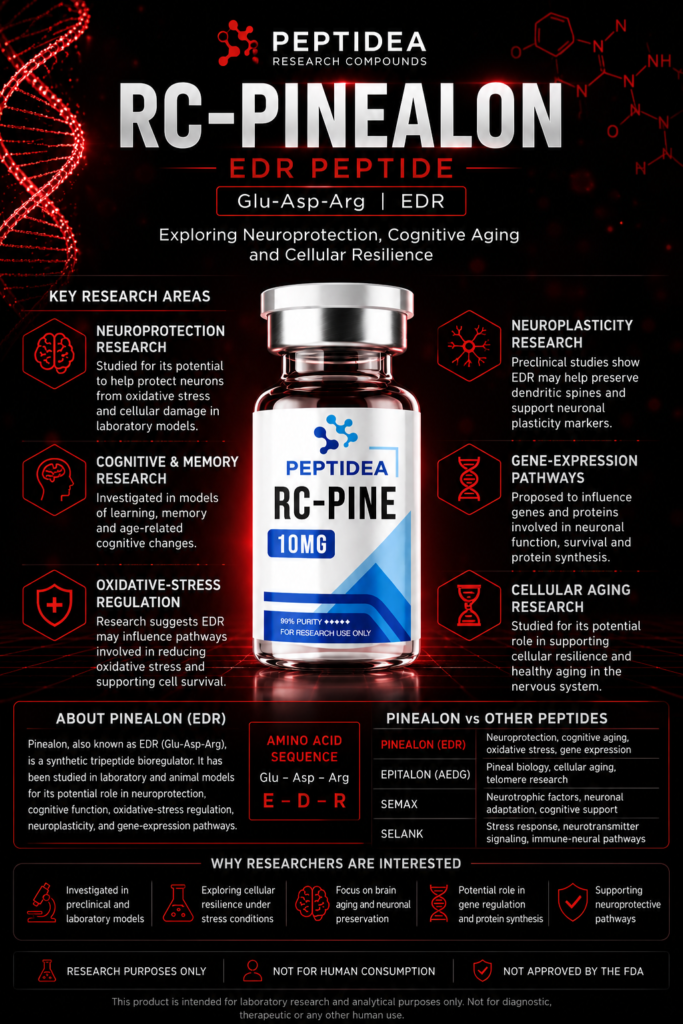
Primary Areas of Pinealon Research
1. Neuroprotective Activity
One of Pinealon’s main areas of investigation is its potential neuroprotective activity.
Laboratory and animal research has examined whether EDR may help protect neuronal cells from damaging conditions such as oxidative stress, metabolic disruption, and other forms of cellular injury.
Published research has reported changes in neuronal survival and apoptosis-related processes following exposure to EDR. These findings remain investigational and do not establish that Pinealon prevents or treats neurological disease in humans.
2. Cognitive and Memory Research
Pinealon has been studied in experimental models involving:
- Learning
- Memory retention
- Hippocampal activity
- Age-related cognitive changes
- Neurological stress
Certain animal studies have reported changes in learning or memory-related measurements after Pinealon administration. Limited published literature has also discussed cognitive observations in human research settings, but the available evidence is not sufficient to establish a clinical benefit.
Pinealon remains an experimental research compound.
3. Oxidative-Stress Regulation
Oxidative stress occurs when the production of reactive oxygen species exceeds a cell’s protective capacity.
Because neuronal cells can be particularly vulnerable to oxidative damage, researchers have examined Pinealon’s possible influence on:
- Reactive oxygen species
- Free-radical activity
- Cellular antioxidant responses
- Cell viability
- Stress-related neuronal damage
Experimental research suggests that EDR may influence pathways involved in oxidative-stress regulation. The precise mechanism and its relevance to human health remain under investigation.
4. Neuroplasticity and Dendritic Spines
Neuroplasticity describes the nervous system’s ability to form, maintain, and reorganize neuronal connections.
Dendritic spines are small structures located on neurons that help support communication between nerve cells. Changes in dendritic-spine density and stability are associated with learning, memory, aging, and several neurological conditions.
Preclinical studies have investigated whether EDR may help preserve dendritic spines and other markers associated with neuronal plasticity under experimental conditions.
These results are preliminary and should not be interpreted as evidence that Pinealon can reverse or prevent cognitive decline.
5. Gene-Expression Research
One of the most distinctive areas of Pinealon research involves gene regulation.
Researchers have proposed that ultrashort peptides may interact with DNA or regulatory regions within cells, potentially influencing the expression of genes involved in neuronal function.
EDR has been studied for possible effects on genes and proteins associated with:
- Neuronal signaling
- Cellular survival
- Protein synthesis
- Oxidative-stress responses
- Neuroplasticity
- Programmed cell death
These proposed mechanisms are based primarily on laboratory and preclinical research.
6. Cellular Aging Research
Pinealon is also studied within the broader field of gerontology and peptide bioregulation.
Researchers are examining whether ultrashort peptides may influence cellular processes that change with age, including:
- Gene regulation
- Protein production
- Mitochondrial stress
- Oxidative balance
- Cellular repair
- Neuronal resilience
Pinealon is sometimes described as a geroprotective research peptide. However, this term reflects an area of investigation and does not mean the compound has been proven to slow aging or extend lifespan in humans.
Pinealon Compared With Other Research Peptides
Pinealon vs. Epitalon
Pinealon
- Amino-acid sequence: Glu-Asp-Arg
- Common abbreviation: EDR
- Primary research emphasis: neuronal function, neuroprotection, oxidative stress, and cognitive aging
Epitalon
- Amino-acid sequence: Ala-Glu-Asp-Gly
- Common abbreviation: AEDG
- Primary research emphasis: cellular aging, pineal biology, circadian pathways, and telomere-related research
They are separate research compounds and should not be treated as interchangeable.
Pinealon vs. Semax
Semax is commonly investigated for signaling pathways involving neurotrophic factors, neuronal adaptation, cognition, and responses to neurological stress.
Pinealon research is more heavily focused on ultrashort-peptide gene regulation, cellular resilience, oxidative stress, and age-related neuronal changes.
Pinealon vs. Selank
Selank is primarily researched in connection with behavioral responses, neurotransmitter signaling, stress-related pathways, and immune-neural communication.
Pinealon is more closely associated with experimental research into neuroprotection, gene expression, cognitive aging, and neuronal cell survival.
Why Researchers Are Interested in Pinealon
Pinealon’s short three-amino-acid structure makes it an interesting subject for studying how relatively simple peptide sequences may influence complex cellular functions.
Research questions involving Pinealon include:
- Can ultrashort peptides influence neuronal gene expression?
- Can EDR improve neuronal resistance to cellular stress?
- Does EDR affect oxidative-stress pathways?
- Can it help preserve markers of neuroplasticity?
- How does it affect aging neuronal cells?
- Are preclinical findings reproducible in controlled human studies?
These questions remain active areas of scientific investigation.
Important Research Limitations
The scientific literature surrounding Pinealon is limited compared with approved pharmaceutical compounds.
Important limitations include:
- Much of the evidence comes from cell-culture or animal studies.
- Several publications originate from a relatively small group of researchers.
- Large, independent, randomized human trials are lacking.
- Long-term human safety has not been established.
- Effective human dosing has not been established.
- Pinealon has not been proven to prevent, diagnose, or treat cognitive or neurological disorders.
Claims involving memory improvement, neuroprotection, anti-aging effects, or disease prevention should therefore be understood as research hypotheses rather than confirmed medical benefits.
RC-PINE at Peptidea
RC-PINEALON is offered as a research compound for qualified laboratory and analytical applications.
Potential research applications may include investigations involving:
- Neuronal cell models
- Oxidative-stress pathways
- Gene-expression analysis
- Cellular-aging models
- Neuroplasticity markers
- Protein-expression studies
- Experimental cognitive-aging research
Research Use Only
RC-PINEALON is sold strictly for:
- Laboratory research
- Analytical testing
- In-vitro investigation
- Educational research
- Chemical reference purposes
Not for human consumption.
Not for veterinary use.
Not intended to diagnose, treat, cure, mitigate, or prevent any disease or medical condition.
The purchaser is responsible for ensuring that all research activities comply with applicable laws, institutional requirements, and laboratory safety standards.
Frequently Asked Questions
Is Pinealon the same as Epitalon?
No. Pinealon is the tripeptide Glu-Asp-Arg, while Epitalon is the tetrapeptide Ala-Glu-Asp-Gly. They are studied for different biological activities.
Is Pinealon a nootropic?
Pinealon is sometimes discussed within nootropic communities because of its cognitive and neuronal research. However, it is more accurately described as an experimental peptide bioregulator. It is not an approved nootropic medication.
Has Pinealon been proven to improve memory?
No definitive conclusion can currently be made. Some preclinical and limited human research has reported cognitive observations, but larger independent clinical studies are needed.
Does Pinealon treat Alzheimer’s disease or dementia?
No. Pinealon has not been proven or approved to treat Alzheimer’s disease, dementia, or any other neurological disorder. References to these conditions concern experimental cell and animal models.
Is Pinealon approved by the FDA?
Pinealon is not an FDA-approved drug for diagnosing, treating, curing, or preventing disease.
What does EDR mean?
EDR represents Pinealon’s three-amino-acid sequence:
- E: Glutamic acid
- D: Aspartic acid
- R: Arginine